
Killarney National Park Without a Tour: On Foot, by Bike and by Car
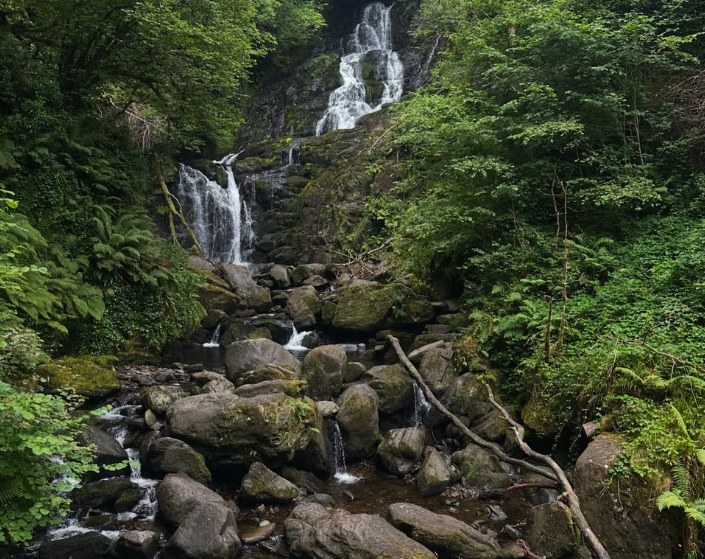
Killarney National Park is free to walk into, at any hour, with no ticket and no gate — so going alone is the default rather than the budget option. This costs and times each way in, and is straight about the three things a guided hour reaches that your own feet cannot.
In this guide
- Can you visit Killarney National Park without a tour?
- Walking in from Killarney town
- Is hiring a bike worth it?
- Can you drive into the park?
- What about the boats?
- What does each way in actually cost?
- What can a guide reach that you cannot?
- Does going alone work with a stroller or limited mobility?
- What is the honest time penalty of going alone?
- What still costs money if you go alone?
- When does booking stop being optional?
- What should you not attempt without a guide?
Can you visit Killarney National Park without a tour?
Yes, completely, and for nothing. Entry is free, twenty-four hours a day, all year, with pedestrian access at all times. There is no gate, no ticket office and no closing time, and the Muckross car and coach parks carry no charge either.
That makes this one of the rare headline attractions where the independent option is not a compromise but the default. Most people who visit the park never book anything at all.
So the honest question is not whether you can go alone. It is what a guided hour adds that your own two feet cannot reach — and there are three answers to that, further down.
Walking in from Killarney town
The town gates at Killarney House on Muckross Road put you under trees within minutes of the centre. From there Knockreer parkland opens out towards Lough Leane, and the Knockreer Circular is a five-kilometre loop that needs no map.
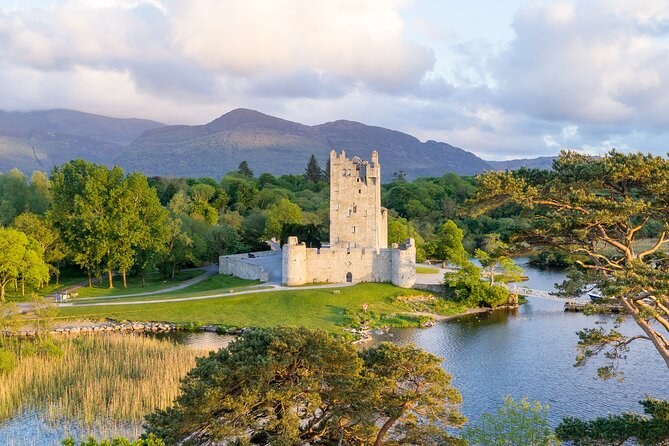
Ross Castle is a short walk further, along Ross Road, and the jetty beside it is where the lake boats leave from. Muckross is about five kilometres south of town on a surfaced path well clear of the traffic — an hour each way at an ordinary pace, which makes it a half-day round trip on foot.
None of that needs planning. There is no route to reserve, no time slot to hit and nothing to carry but weather gear, and the gates are open at four in the morning if that is when you want to walk through them.
Fourteen waymarked trails are signposted from the official routes, from a one-kilometre boathouse stroll to the seven-kilometre Old Kenmare Road. Distances and gradings sit on the walking page rather than here.
Is hiring a bike worth it?
For Muckross, yes. Bikes are hired in Killarney town by the day, and the surfaced roads through the Muckross estate and out to Dinis are the standard route. What takes an hour on foot takes twenty minutes on wheels, and the whole southern half of the park comes into range.
The catch is that the woodland paths are not all rideable and the estate roads get busy with walkers and traps in high summer. A bike is a way of covering the distances between the good bits, not a way of experiencing them.
Can you drive into the park?
To its edges, not through it. The N71 runs south past Muckross to Torc, Ladies’ View and Moll’s Gap, and there are car parks at Muckross, at the foot of Torc Waterfall, on Ross Road and at the cathedral near Deenagh Lodge.
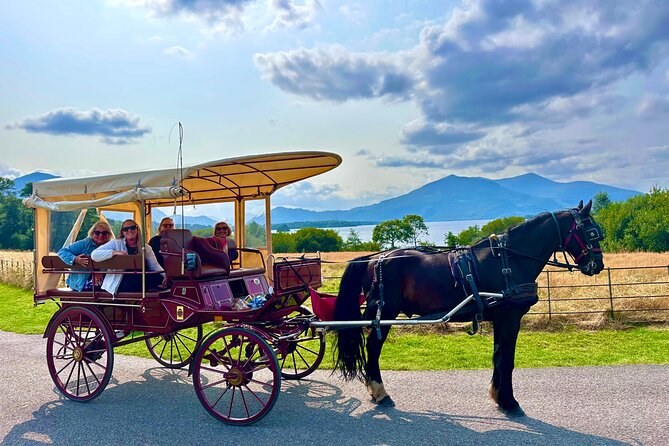
Beyond those the estate roads are closed to private traffic, which is exactly why the traps exist. A car gets you to five entrances kilometres apart; it does not get you along the lakeshore under the oaks.
What about the boats?
Boats cross Lough Leane to Innisfallen Island from the jetty at Ross Castle, and longer trips run through the lakes to Lord Brandon’s Cottage at the head of the Gap. They are arranged at the jetty on the day rather than booked in advance here.
The water is the one channel that shows you the shape of the place — three lakes on a limestone shelf with sandstone mountains behind. If you only add one paid thing to a free day, this is a strong candidate.
What does each way in actually cost?
Door-to-door from Killarney town centre, for one adult, with no ticketed attractions added. Times are for reaching Muckross, which is the usual destination.
| Way in | Cost | Town to Muckross | What it reaches | What it cannot |
|---|---|---|---|---|
| On foot | Nothing | About an hour each way | Knockreer, Ross Island, the lakeshore paths, all fourteen waymarked trails | Distance — the far lakes stay out of range |
| Hired bike | Day hire in town | About 20 minutes | Muckross, Dinis, the surfaced estate roads | Rough paths and the woodland tracks |
| Own car | Nothing to park | About 10 minutes | Five entrances, the N71 viewpoints, Torc | Everything past the car parks |
| Boat from Ross Castle | Paid at the jetty | Not applicable | Innisfallen, the lakes, Lord Brandon’s Cottage | The woods |
| Guided trap | From $52 | Picked up in the town centre | Estate roads closed to cars, plus commentary | Ground beyond an hour’s trotting |
Parking at the Muckross car and coach facilities carries no charge. Bike hire rates are set by the shops in town and are not booked through here.
What can a guide reach that you cannot?
Three things, and only three, but they are not nothing.
- The closed estate roads. The gravel roads through the demesne woods are shut to private vehicles. On foot they are hours away; on a trap they are the whole hour.
- The commentary. Your jarvey has the folklore, the history and the name of every turn in the road. It is the part of the hour people repeat to each other afterwards.
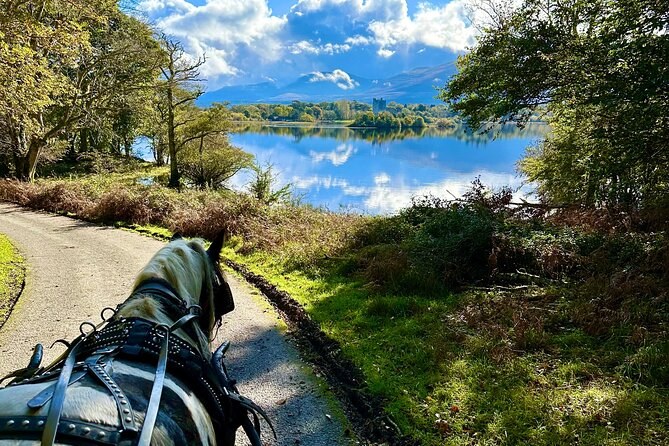
- The bridle paths. The riding routes along the shore of Lough Leane are not walking routes, and the horse gets closer to the deer than you will on foot.
Everything else — the friary, the waterfall, the gardens, the lakes, the trails — is open to anyone who walks up to it, free, without booking.
Does going alone work with a stroller or limited mobility?
Partly, and the park is better set up for it than most Irish attractions. There are level surfaced paths at both Muckross and Knockreer, wide enough for a buggy or a wheelchair and graded gently, and the Muckross car park sits at the head of them with no charge to use it.
What does not work is Ross Castle’s interior, reached by a steep incline, and the woodland and mountain trails, which are rough underfoot. The waterfall involves a short climb of steps from its car park.
None of the guided departures here is described as wheelchair accessible by its operator. Both carriage tours take strollers and one carries infant seats, so a trap is a workable answer for a family that cannot walk the distances.
What is the honest time penalty of going alone?
Roughly two hours a day, spent moving rather than looking. Walking from town to Muckross and back is two hours of surfaced path, which is pleasant but is not why you came. A bike or a car removes most of that; a trap removes it and replaces it with content.
The other penalty is decision cost. Fourteen trails, five entrances and three ticketed sites take some sorting out, and a guided hour hands the sorting to someone else. Whether that is worth an hour’s fare depends entirely on how much of your holiday you want to spend planning.
What still costs money if you go alone?
Only the buildings, and only three of them. Muckross House is €9.00 for an adult in 2026, the Traditional Farms €11.00, a joint ticket €18.00, and the interior of Ross Castle €5.00. Muckross Abbey costs nothing and never has.
Children, students, seniors and families all pay less, and a family of two adults and two children can do house and farms together for €39.00. The full price list, and what a day comes to for four different parties, sits in the tickets and prices guide.
When does booking stop being optional?
When your time is short, when the weather is bad, or when the ground you want is closed to you. An hour is the smallest useful unit of this park, and a trap is the only way to spend a whole hour of it inside the woods rather than walking towards them.
It also stops being optional when someone in the group cannot walk five kilometres. The traps take strollers, one carries infant seats, and the seat is dry. That is a practical answer to a practical problem.
What should you not attempt without a guide?
The mountain ground, in poor visibility. The Old Kenmare Road and the Mass Path are graded strenuous, the weather here changes inside an hour, and phone signal is not something to plan around on the high sections.
Swimming is listed among the park’s own activities and people do it, but there are no lifeguards on any of the lakes. Judge it yourself, and judge it soberly.
Questions people ask before they book
Is Killarney National Park free to enter?
Yes. Entry is free, twenty-four hours a day, all year, with pedestrian access at all times. Muckross House, the Traditional Farms and the interior of Ross Castle charge separately, and the park, the gardens, the woods and every trail do not.
Do you need to pay to park at Killarney National Park?
No. The Muckross car and coach facilities carry no parking charge, and the cathedral car park near Deenagh Lodge is also free. In July and August the Muckross parks fill from mid-morning, so early is easier than cheap.
Can you walk into Killarney National Park from the town?
Yes, in a few minutes. The gates at Killarney House on Muckross Road open straight onto Knockreer parkland. Muckross is about five kilometres further south on a surfaced path kept clear of the road.
Is it better to cycle or walk in Killarney National Park?
Cycle if you want Muckross and Dinis in a day, walk if you want the woodland paths and the shoreline. The surfaced estate roads suit a bike; the waymarked trails and the quieter ground do not.
Can you drive through Killarney National Park?
You can drive the N71 along its eastern side to Torc, Ladies’ View and Moll’s Gap, and park at five entrances. The estate roads through the demesne woods are closed to private traffic, which is why the horse-drawn traps run there.
Is a guided tour worth it if the park is free?
It buys three things nothing else does: the estate roads closed to cars, a driver’s commentary, and the bridle paths on horseback. If none of those matters to you, a free day here is a complete day.
Tours that fit this trip
If the arithmetic sends you the other way, these are the three shortest guided hours.
Working out how much time to give it? How long you need sets out four shapes of day. Every waymarked route with its distance and grading is on the walking and hiking page. Guided options and fares: Killarney National Park Tours.