
14 Killarney National Park Facts That Will Surprise You
Fourteen things that are true and sound like they should not be
Some of these are records, some are accidents of geology, and one is a Victorian craze that nearly wiped out a fern. All of them come from the National Parks and Wildlife Service, the Office of Public Works and the Muckross House Trust.
1. The deer have been here since the Neolithic
Killarney National Park holds the last surviving indigenous red deer herd in Ireland, present in these hills since Neolithic times. Every other red deer herd in the country descends from Scottish animals introduced later. This is the original population, still on its original ground.
2. The stags weigh as much as a small motorbike
A mature red deer stag here reaches around 220 kg; hinds go up to 110 kg. That is worth holding in mind during the autumn rut, when the stags are noisy, visible and best watched from a distance.
3. There is a yew wood the size of 35 football pitches
Reenadinna Wood, on the Muckross peninsula, is the largest area of yew woodland in Western Europe: 25 hectares of it. Not the largest in Ireland — the largest in Western Europe, and most visitors walk past the turning.
4. Those yews are only 200 years old
The trees in Reenadinna are estimated at 200 to 250 years, which for yew is young. The wood is a Special Area of Conservation and it grows on limestone pavement, a soil so thin that almost nothing else will take it.
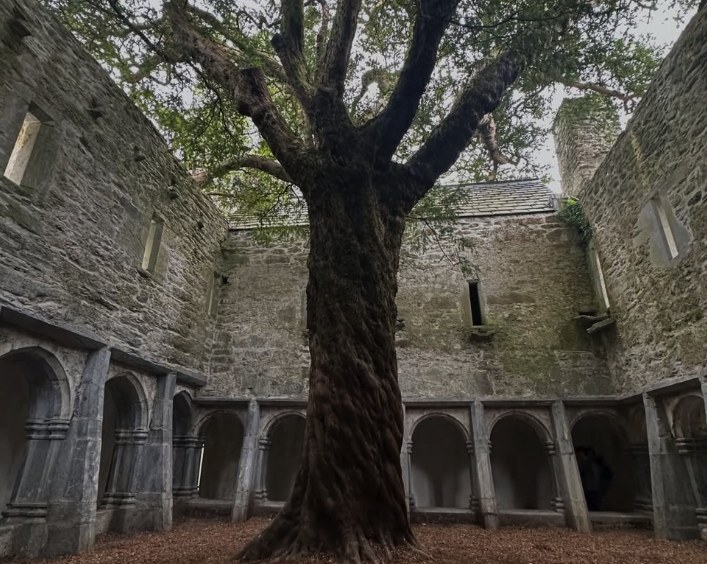
5. A single yew in a roofless cloister is older than the wood
The tree filling the cloister at Muckross Abbey is thought to be up to 400 years old — older than the whole of Reenadinna. Charles Smith described it in 1756 as spreading over the cloister niches like a great umbrella, and it still does exactly that.
6. Cromwell’s men took the roof off on purpose
Muckross Abbey was founded in 1448 and sacked during the Desmond Rebellions. In 1652 Cromwell’s forces raided it and removed the roof specifically to make it uninhabitable. It has stood open to the sky for more than 370 years and the walls, tower and cloister are all still up.
7. The most extensive native woodland in Ireland is here
The oakwoods on Old Red Sandstone in this park are the most extensive remaining area of native woodland in the country, with sessile oak canopies standing 13 to 20 metres high. They are of national and international importance, and they are the reason the valley was protected at all.
8. Eagles came back after a century away
White-tailed sea eagles had not been seen in Ireland since the early twentieth century until a reintroduction programme based in this park brought them back. Their wingspan reaches 2.4 metres. Watch over Lough Leane and the Upper Lake for something obviously too big to be a buzzard.
9. Some of the plants belong in Portugal
The park carries a set of species known as the Lusitanian flora — plants found in Iberia and almost nowhere else in northern Europe. St Patrick’s cabbage and kidney saxifrage are the two you are most likely to notice, growing straight out of wet rock.
10. A fashion for ferns nearly finished one off
The Killarney fern is a protected species, and Victorian fern collecting almost eliminated it. The craze was thorough and the fern was fashionable. What survives is deliberately not signposted, which is the whole reason it survives.
11. It is a Biosphere Reserve, not a World Heritage Site
The park was designated a UNESCO Biosphere Reserve in 1981, on the strength of its rare flora and its range of habitats. That is a different designation from World Heritage status, which it does not hold, whatever some tour marketing says.
12. Ireland’s first national park started as a gift
The Muckross Estate was presented to the State in 1932, creating the country’s first national park. The Bourn Vincent Memorial Park Act of that year is still the legal basis on which Muckross House is managed today — nearly a century later, still load-bearing.
13. The park has a hard half and a soft half
Old Red Sandstone in the south, Carboniferous limestone in the north, and the lakes gathered along the boundary between them. Lough Leane sits almost entirely on limestone, which is why its shores are green while mountain ground a few kilometres away is bare. The landscape page follows it through.
14. You can still walk in for nothing, at any hour
25,425 acres, no gate, no ticket, no closing time. In a country where most headline attractions are ticketed, the largest one is free at three in the morning in January.
15. The lakes sit on two different rocks
Lough Leane lies almost entirely on Carboniferous limestone; the Upper Lake sits in a hollow cut from Old Red Sandstone. Two lakes a few kilometres apart, on rock hundreds of millions of years different in age, and the plant life on their shores reflects it exactly.
16. A single Act of 1932 still runs Muckross House
The Bourn Vincent Memorial Park Act, passed when the estate was handed over, remains the legal instrument under which Muckross House is managed today. Most legislation of that vintage has been replaced several times over. This one is still doing the job it was written for.
17. The last Kenmare mansion is a classroom
Knockreer House, the final surviving house of the Kenmare estate, is now the park’s education centre rather than a visitor attraction. You can walk the parkland around it — five kilometres of it on the Knockreer Circular — but the house itself works for a living.
The facts in one table
| Fact | Figure | Why it matters |
|---|---|---|
| Park area | 25,425 acres / over 10,000 ha | Ireland’s first, from 1932 |
| Reenadinna yew wood | 25 hectares | Largest in Western Europe |
| Yew age, Reenadinna | 200–250 years | Young, for yew |
| Cloister yew, Muckross Abbey | Up to 400 years | Recorded in 1756 |
| Oak canopy height | 13–20 m | Most extensive native woodland in Ireland |
| Red deer stag weight | Around 220 kg | The only native herd left |
| Sea eagle wingspan | Up to 2.4 m | Reintroduced after a century |
| Biosphere designation | 1981 | Not World Heritage |
Where to see the surprising bits
- The cloister yew: Muckross Abbey, free, ten minutes from the Muckross car park.
- Reenadinna: a short detour off the Muckross paths — see the trail list.
- The red deer: Knockreer open ground, early morning.
- The oakwoods: Arthur Young’s Walk, 5.6 km from Muckross.
- The geology: Ladies’ View, from the car park.
Practicalities for all of them — hours, parking, prices — are on the visiting page, and each place is described in full under things to do.
Tours that fit this trip
The quiet formats, which are the ones that put you near the deer and the old yews.
See the ones you can actually stand in: browse Killarney National Park Tours, or read every lake, wood and landmark to work out where each of these sits.